
“I Want the Same Opportunity as Everyone Else”: Access to Mathematics for Learners with Visual Impairment at Okuapemman School
When Erica Tetteh was told in her final year of Junior High School (JHS) that she could study mathematics at Senior High School (SHS), she did not believe it was possible. For years, the reality for learners with visual impairment progressing from JHS to SHS has been the absence of mathematics at the SHS level, a barrier that constrained their subject choices, closed doors to certain tertiary programmes and narrowed their life options.
So, what had changed?
In 2024, the National Council for Curriculum and Assessment (NaCCA) and Ghana Education Service (GES) through its Special Education Division (SpED), with support from T-TEL and the Mastercard Foundation, began a targeted reform to redefine the pathway for inclusive education. A significant component of this reform was a structured approach that makes mathematics accessible to learners with visual impairment through adapted curricula and assistive technology. Okuapemman School became the first SHS to implement this approach opening a pathway that other schools soon signalled they were ready to follow.
A diagnostic exercise in 2024 showed that ten out of sixteen blind and low vision learners at Okuapemman SHS had already met a foundational mathematics benchmark, confirming both their interest and capacity. What they lacked was a clear pathway for them to learn mathematics at SHS level and sit for examinations. The core problem was not willingness but access – insufficient tactile materials, limited braille resources, scarce teacher expertise and lack of assistive devices in classrooms.
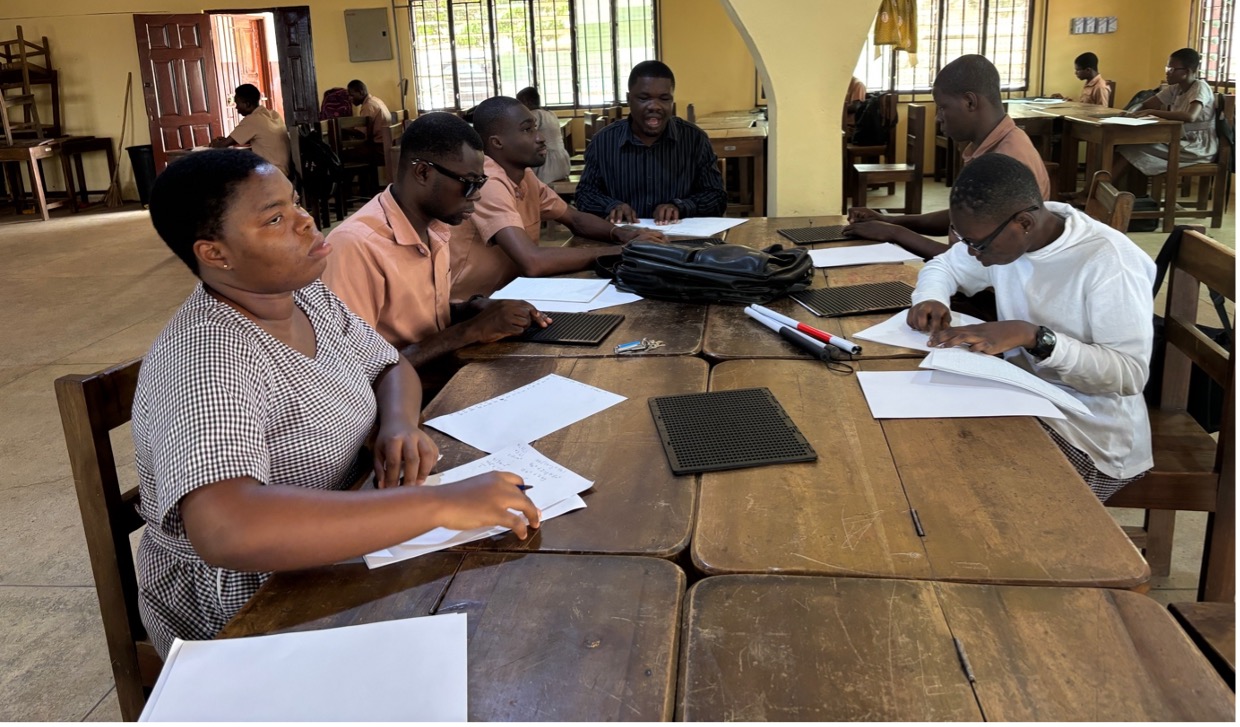
Learners with visual impairment and a representative from the National Council on Persons with Disability (NCPD) during the 2024 diagnostic assessment at Okuapemman SHS
The intervention was comprehensive, spanning different layers of support. First, the curriculum and teaching and learning materials were adapted. This involved translating key concepts into tactile and braille formats. Learning materials were redesigned for non-visual access, and alternative methods were developed for tasks that traditionally rely on sight, such as interpreting graphs and diagrams.
The second element was technology. At Okuapemman SHS, teachers and learners benefited from resource packages and training that translated policy into practical classroom support. The provision of “Math in a Box” kits and twenty laptops equipped with screen readers along with specialised software to support access to mathematical content demonstrated a strong commitment to making mathematics accessible. These laptops supplemented the existing materials at the school’s resource centre, expanding its capacity to support learners during lessons and strengthen the centre’s ability to provide ongoing training.
Thirdly, teacher capacity was built. Specialists in teaching mathematics to blind and low vision learners were supported by a partner network that included GES, NaCCA, National Council on Persons with Disability (NCPD) and the Ghana Blind Union (GBU). GES and school management went a step further by approving extended vacation arrangements on two occasions, giving teachers and learners extra time to cover more topics and develop ICT skills. Finally, the approach integrated assessments that are responsive to learner needs and preferences.
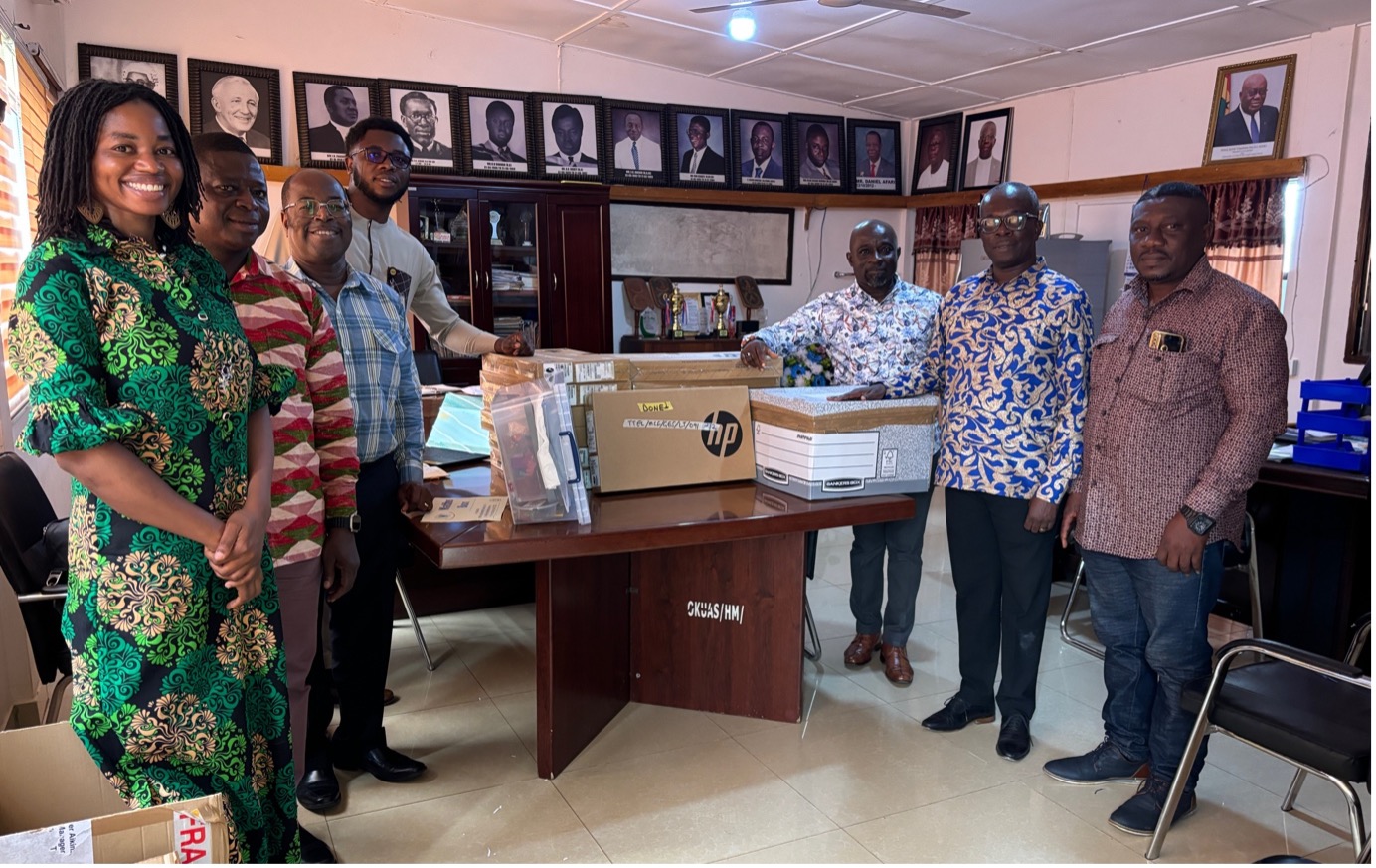
An officer from GES SpED, accompanied by T-TEL staff members (left), donates 20 laptops and ‘Math in a Box’ kits to Okuapemman SHS management (right), received by the Headteacher, Assistant Head and a teacher
With these interventions, the reform was set in motion by a shared belief that the ability to study mathematics should not depend on sight.
It is a reform that set Erica’s educational journey on a different trajectory. Now, in Form 2, Erica says she is studying a subject previously off limits with a mix of doubt and determination. “I want to write mathematics [WASSCE] because I want the same opportunity as everyone else. Our seniors did not study mathematics and they are struggling at the tertiary level but I have an advantage here. When I was told I would study mathematics at SHS level, I did not believe it was possible until I got here.”
Erica’s words reflect both the challenges she faces and the ambition that drives her. She also highlights the practical realities: “Some topics take longer to understand and require patient guidance. It is not easy, but once you understand it, you feel confident. You feel like you belong in the class.”
Archibold, another Form 2 learner, previously attended a mainstream school, where he relied on large print and benefited from early exposure to digital tools. Now at SHS, assistive technology supports his studies and examinations in the same way as his sighted peers. “I was lucky to have exposure to computers and digital tools early on. Now at SHS, the school allows me to use assistive technology for my exams which helps me keep up and be confident.” His ambition is clear: to write the WASSCE in 2027 and become a lecturer.
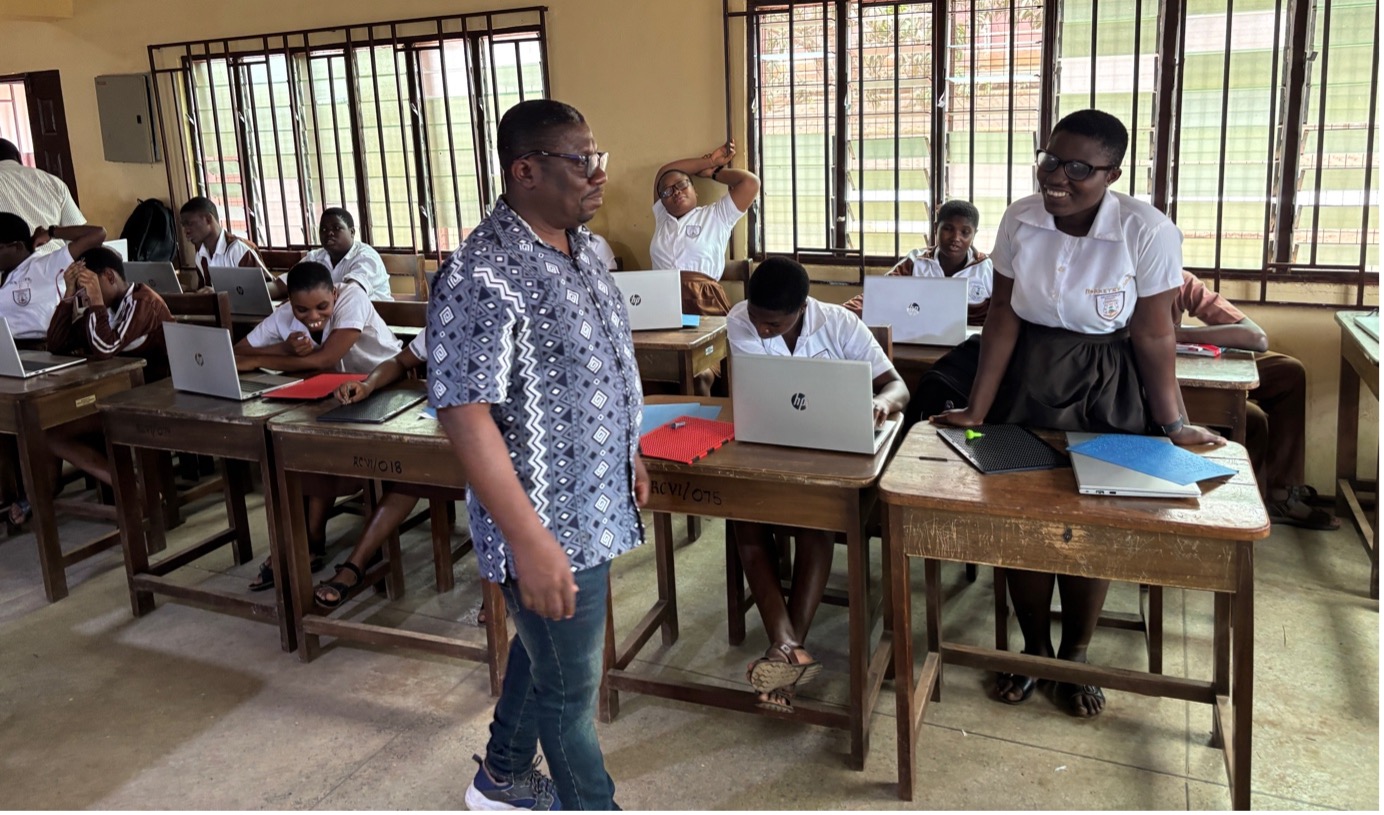
A teacher during a mathematics lesson for blind learners at Okuapemman SHS
What has made the approach successful is the coordination behind it. NaCCA and GES worked with GBU and teachers of learners with visual impairment to design materials that are practical and usable in real classroom settings. This collaboration aims to build sustainable pathways into mathematics for blind and low vision learners. The use of assistive technology, including specialised devices and screen readers, enables learners to study mathematics on equal terms with their sighted peers.
So far anecdotal feedback suggests strong potential scaling while also revealing challenges that must be carefully managed. Key indicators show that learners with visual impairment can study mathematics when the right support systems are in place. There are positive signals in the data. The diagnostic benchmark confirmed readiness and capacity, learners are engaging with the adapted curriculum and technology is supporting inclusive teaching and assessment. Yet issues remain about infrastructure gaps, the pace of teacher upskilling and the sustainability of funding as the intervention expands.
As the pilot at Okuapemman School shows early promise and receives positive feedback, six other schools – Mawuli School, Adidome SHS, Ghana National College, Sirigu SHS, Wenchi SHS and Wa SHS have expressed interest in introducing the adapted mathematics curriculum so that learners with visual impairment in their schools can also study mathematics.
This initiative aligns with a broader reform agenda centred on equity and inclusion in Ghana’s secondary education system. The rollout is being overseen by NaCCA, GES with support from the Ministry of Education and it relies on monitoring to ensure there is consistent support.
The lessons from Okuapemman point to key areas for strengthening access to mathematics for learners with visual impairment.
First, ongoing professional development for teachers is essential. Success depends on sustained capacity building in specialist techniques for teaching mathematics to learners with visual impairment, alongside strengthening general mathematics pedagogy.
Second, resources must be reliably available. Beyond the initial hardware and software, schools require a steady supply of teaching and learning materials, periodic updates to digital content and consistent technical support.
Third, assessment strategies must reflect inclusive practices, ensuring that learners receive appropriate accommodations such as braille papers, enlarged print and use of assistive technology.
Finally, ensuring equity is critical. The goal is not only to make mathematics accessible at one school but to extend equitable opportunities for learners with visual impairment across all regions.
For learners like Erica, this change means being able to study mathematics and confidently plan for the future. “The system used to decide for me, but now I have a chance to follow the path I want.”